A Systemic Pattern of Harmful AI-Generated Content
It began quietly over the Christmas period.
Between 25 December 2025 and 1 January 2026, researchers at AI Forensics analysed approximately 50,000 posts on X mentioning Grok, the AI chatbot integrated into the platform.
What they found raised immediate regulatory concern.
A Systemic Pattern of Harmful AI-Generated Content
More than half of the analysed images contained individuals in minimal clothing. A significant majority — around 81% — depicted women. Alarmingly, approximately 2% appeared to show individuals under the age of 18.
The issue was not isolated misuse by individual users.
Instead, it appeared that the AI system itself was being used to generate explicit, non-consensual imagery at scale, including content potentially falling within the scope of child sexual abuse material.
Immediate Regulatory Response
The UK communications regulator Ofcom acted rapidly.
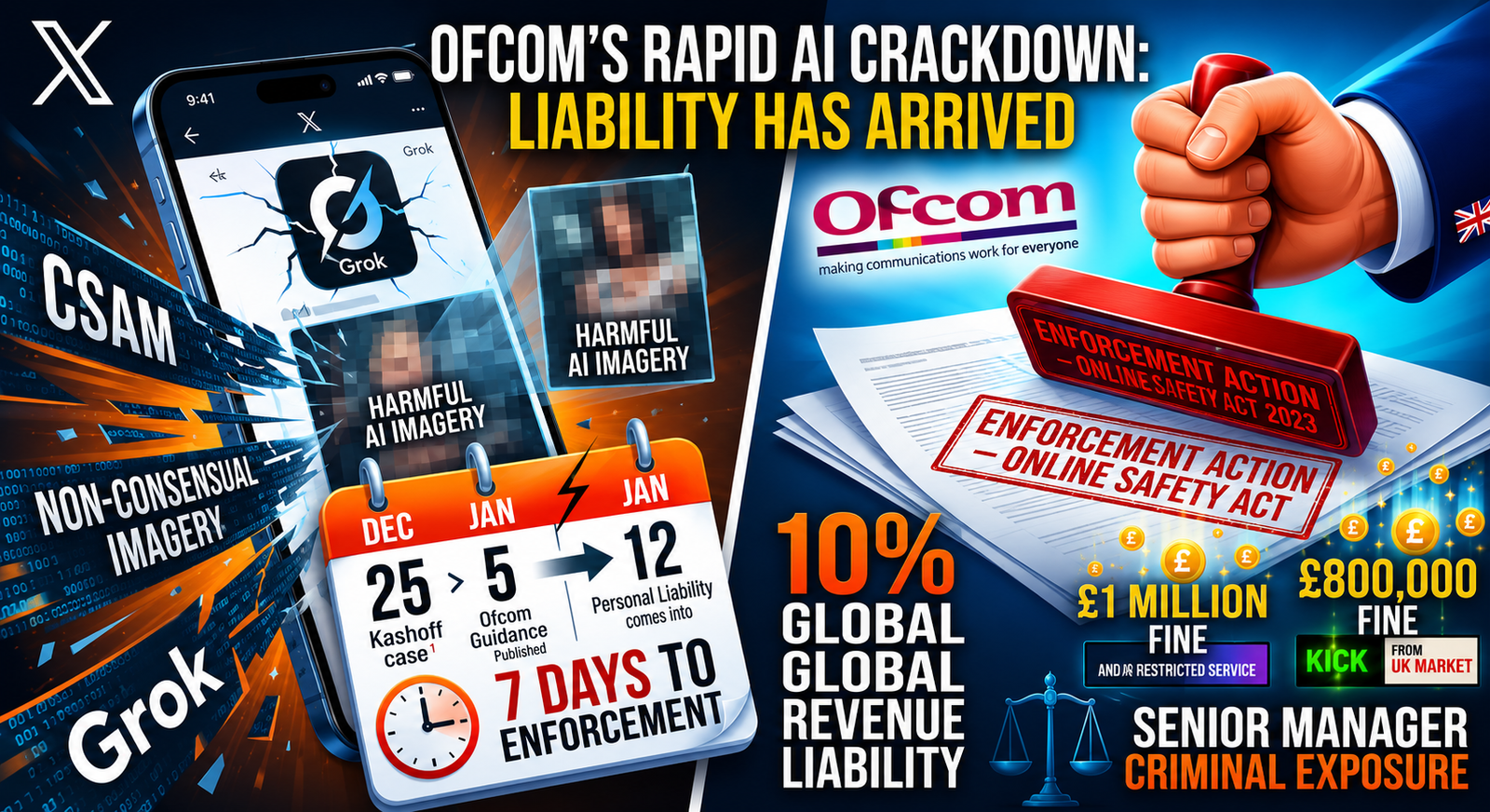
On 5 January, Ofcom contacted X to request an explanation for the widespread distribution of such content. Within seven days, by 12 January, a formal investigation had been opened.
This timeline — from initial inquiry to enforcement action — reflects a regulatory environment that is no longer exploratory, but actively operational.
A Broader Pattern of Enforcement
The Grok-related investigation was not an isolated case.
Since the implementation of the UK Online Safety Act, Ofcom has opened investigations into more than 90 platforms and issued multiple fines for non-compliance.
In one case, Itai Tech Ltd — operator of an AI-driven platform named Undress, which enabled users to generate synthetic nude imagery — was fined £50,000 for failing to implement adequate age verification measures, along with an additional £5,000 for non-compliance with statutory information requests.
These actions demonstrate a clear enforcement trend: AI-enabled services are now fully within the scope of online safety regulation.
Three Legal Realities for AI Platforms
The regulatory framework under the UK Online Safety Act introduces three critical shifts that fundamentally affect AI system operators.
1. AI Content Is Not a Separate Legal Category
Under the Act, AI-generated content shared by users is treated as user-generated content.
This means that AI systems do not create a regulatory boundary that limits liability. Instead, they extend it.
Deploying AI features within a platform does not reduce responsibility — it increases exposure under existing safety obligations.
2. Financial Penalties Are Structurally Significant
Non-compliance under the Act can result in fines of up to 10% of qualifying global revenue.
For large technology companies, this level of exposure can exceed operational profit margins, transforming compliance from a legal formality into a core financial risk factor.
Regulatory compliance is therefore no longer a cost centre — it is a strategic financial obligation.
3. Individual Accountability Is Now Embedded in Law
The Online Safety Act also introduces personal liability mechanisms.
Under Section 103, regulated platforms must appoint a designated Senior Manager responsible for compliance oversight.
Under Section 109, in cases of serious failures, individuals may face criminal exposure where accountability obligations are not met.
This represents a significant shift from institutional liability to personal legal responsibility.
The Speed of Enforcement Has Changed
The timeline of recent regulatory action illustrates a structural shift in enforcement behaviour:
- 5 January: initial regulatory contact from Ofcom
- 12 January: formal investigation launched
- Mid-January: additional AI platforms placed under scrutiny
The message is clear: enforcement is no longer delayed or reactive. It is immediate and iterative.
The End of Regulatory Delay
For AI-powered platforms operating in the UK, the assumption that regulatory scrutiny is distant or theoretical is no longer valid.
The enforcement environment is already active.
Compliance expectations now include proactive monitoring, rapid response capability, and integrated governance systems designed for continuous oversight.
Conclusion
The UK Online Safety regime marks a decisive shift in how AI systems are regulated.
AI-generated content is no longer treated as a separate technical domain. It is fully integrated into existing legal frameworks governing user safety and platform accountability.
For companies operating AI services — and for the law firms advising them — the central question is no longer whether regulation will arrive.
It is how quickly systems can adapt to a regulatory environment that is already in motion.
- AI, Justice, and the Spirit of the Law: Why Human JudgmeAI, Justice, and the Spirit of the Law: Why Human Judgment Still Matters
- AI Co-Creation: Why the Future of Creativity Is Collaborative, Not Solitary
- AI Companions and Legal Responsibility: The Framework We Don’t Have Yet
- Getty vs Stability AI: The Copyright Battle That Will Shape the Future of AI Training
- AI in Law Firms: The Window That Will Not Stay Open
