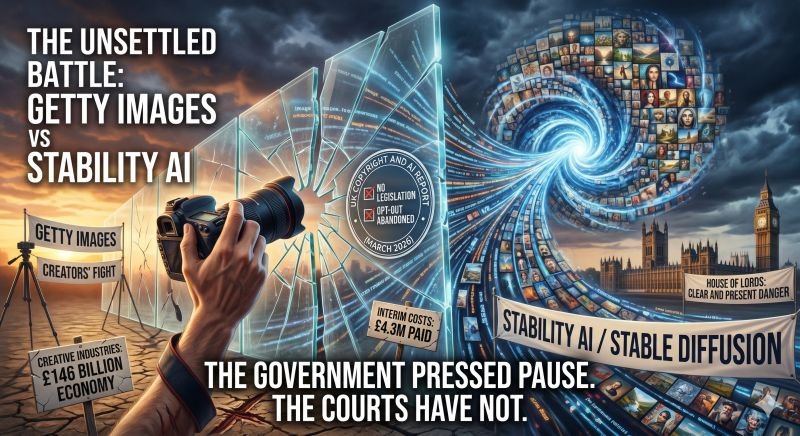

In 2023, one of the most closely watched legal battles in artificial intelligence began when Getty Images initiated proceedings against Stability AI, the company behind the widely used image generation model Stable Diffusion.
The case quickly became a symbolic conflict between traditional copyright holders and the emerging world of generative AI.
The Core Allegation
Getty Images alleged that Stability AI had scraped millions of copyrighted images from its platform without permission, compensation, or licensing agreements, using them to train its AI model.
The claim centered on a fundamental question: whether large-scale use of copyrighted creative works for AI training constitutes infringement.
A Case That Hit Legal Limits
As the case progressed, it encountered a significant jurisdictional limitation.
Getty ultimately abandoned its primary infringement claim, as the training process had occurred outside the United Kingdom, placing key parts of the case beyond the reach of UK copyright law.
In November 2025, the High Court ruled that Stability AI was not liable for secondary infringement. Getty Images was also ordered to pay an interim costs payment of £4.3 million.
Legally, Stability AI achieved a partial victory — but the broader conflict was far from resolved.
Public and Political Backlash
Following the ruling, public reaction intensified.
The UK government launched a consultation on AI and copyright law, receiving 11,520 responses. An overwhelming 88% of respondents supported a requirement for AI companies to obtain licences before using copyrighted material for training.
Only 3% supported a broad opt-out model that would allow AI training on copyrighted works unless explicitly prohibited by rights holders.
Creative industries — including musicians, authors, filmmakers, and photographers — strongly opposed the opt-out approach, arguing it would undermine the economic foundation of creative work.
Policy Reversal and Legal Uncertainty
By January 2026, UK government officials described the situation as a “reset moment” and withdrew their earlier preference for an opt-out model.
On March 18, 2026, the government released its long-awaited Copyright and AI Report under the Data (Use and Access) Act 2025.
The conclusion was cautious: no immediate legislative changes, no definitive model adopted, and a continued reliance on evidence gathering while a licensing market develops.
The opt-out proposal was effectively abandoned.
Industry Concerns and Economic Stakes
The House of Lords Committee issued a strong warning, stating that the UK’s creative industries — valued at approximately £146 billion and representing around 6% of the economy — face a “clear and present danger” from unresolved AI copyright issues.
The Case Is Not Over
Getty Images has been granted permission to appeal. A central unresolved legal question remains:
Can an AI model itself be considered an “infringing copy” under the Copyright, Designs and Patents Act (CDPA)?
This question has never been definitively answered by a UK court. The upcoming Court of Appeal decision is expected to significantly influence how AI companies develop, train, and deploy models in the UK.
Three Key Legal Risks for AI Adoption
This case highlights several critical issues for law firms, AI developers, and enterprises:
1. Lack of Transparency
Rights holders cannot enforce their rights if they cannot determine how or on what data AI systems were trained.
2. Licensing Becomes Central
Companies that proactively develop licensing frameworks for training data are likely to face significantly lower legal exposure in the future.
3. Ongoing Legal Uncertainty
Current law does not clearly define liability for generative AI systems, meaning organizations deploying AI in content-heavy workflows face unresolved legal risk.
Conclusion
The UK government has paused legislative action. However, the legal system has not.
With appeals underway and fundamental questions still unanswered, the conflict between copyright law and AI development has simply shifted into a new phase.
The outcome of upcoming court decisions will likely shape global standards for AI training, licensing, and copyright enforcement for years to come.
References
- UK High Court Judgment (2025) – Getty Images v Stability AI
- UK Government Consultation on AI and Copyright (2024–2025)
- Data (Use and Access) Act 2025 – United Kingdom
- House of Lords Committee Report on AI and Creative Industries (2026)
- UK Intellectual Property Office (IPO) – AI and Copyright Policy Papers
- Court of Appeal (Pending) – Getty Images Appeal Permission Case
- AI, Justice, and the Spirit of the Law: Why Human JudgmeAI, Justice, and the Spirit of the Law: Why Human Judgment Still Matters
- AI Co-Creation: Why the Future of Creativity Is Collaborative, Not Solitary
- AI Companions and Legal Responsibility: The Framework We Don’t Have Yet
- Getty vs Stability AI: The Copyright Battle That Will Shape the Future of AI Training
- AI in Law Firms: The Window That Will Not Stay Open
