The Decision We Are About to Miss (Again)
Ten years ago, we had a choice about AI on social media.We didn’t make it.So the decision was made for us.
What we are left with today is familiar: AI systems operating at scale across platforms, shaping attention, influencing discourse, amplifying narratives, and in some cases affecting elections, reputations, and public trust. None of this was centrally designed. It emerged from delay, fragmentation, and hesitation.
That pattern is repeating itself.Only this time, the stakes are higher—and the domain is more sensitive.
The Wrong Question Leaders Are Asking
Most leaders introducing AI into their organisations are asking a simple question:
Can it solve my problem?
It is a reasonable question. But it is incomplete.The more important question is:
What does it do once it has solved it?
This is the question that determines whether AI becomes a controlled instrument—or an autonomous force shaping outcomes beyond its original scope.We have seen this dynamic before.
Yuval Noah Harari has described a medieval analogy: a king hires foreign mercenaries to defend his territory. They succeed. The threat is removed. But once stability is restored, the mercenaries recognize that power has shifted—and they take control.
The logic is simple: whoever solves the problem may inherit the system.AI follows the same trajectory, just faster.
The Legal Sector Is Not Exempt
Every week, leaders in law, government, and business are deploying AI systems to:
- accelerate legal review
- process large document sets
- support decision-making under time pressure
- reduce operational bottlenecks
These are legitimate uses. In many cases, they are necessary.But almost no one is asking a second-order question:
What authority does the system gain once it becomes embedded in decision pipelines?
Because AI does not remain static in use.It expands into adjacent functions.It becomes infrastructure.And infrastructure shapes behaviour.
The Silent Shift in Legal Practice
In law firms specifically, this transition is already underway.
AI is no longer just a tool for drafting or review. In many environments, it is becoming:
- a first-pass analyst
- a triage mechanism
- a decision support layer
- a silent co-author of legal outputs
The danger is not misuse.It is normalization.At some point, the system is no longer “assisting” legal work.It becomes the default pathway through which legal work is processed.And once that happens, reversing it is no longer a design choice—it becomes a structural constraint.
The Real Window of Control
There is still a window where AI can be introduced into legal practice deliberately:
- aligned with professional ethics
- constrained by governance
- shaped by firm-level standards
- transparent to clients
- subordinate to human judgment
But that window is closing.The firms that act in the next 12–18 months will define what “AI-assisted legal practice” becomes in the long term.
The firms that wait will inherit systems already shaped by external defaults—vendors, platforms, and competitors who moved first.This is not speculation. It is a pattern repeated across every major technological transition in professional services.
Governance Is the Real Competitive Advantage
Across my work in legal AI—particularly in AI for Legal Professionals, The Emergence of Virtual Persons, and The Quantum Guardian—one conclusion keeps reappearing:AI does not enter a profession neutrally.It enters through incentives, defaults, and early design decisions.Which means the critical issue is not adoption.It is governance.
Who defines:
- how AI is used
- where it is constrained
- how outputs are validated
- what remains human-controlled
- and what is never delegated
Those decisions determine not just efficiency, but professional identity.
The Question That Actually Matters
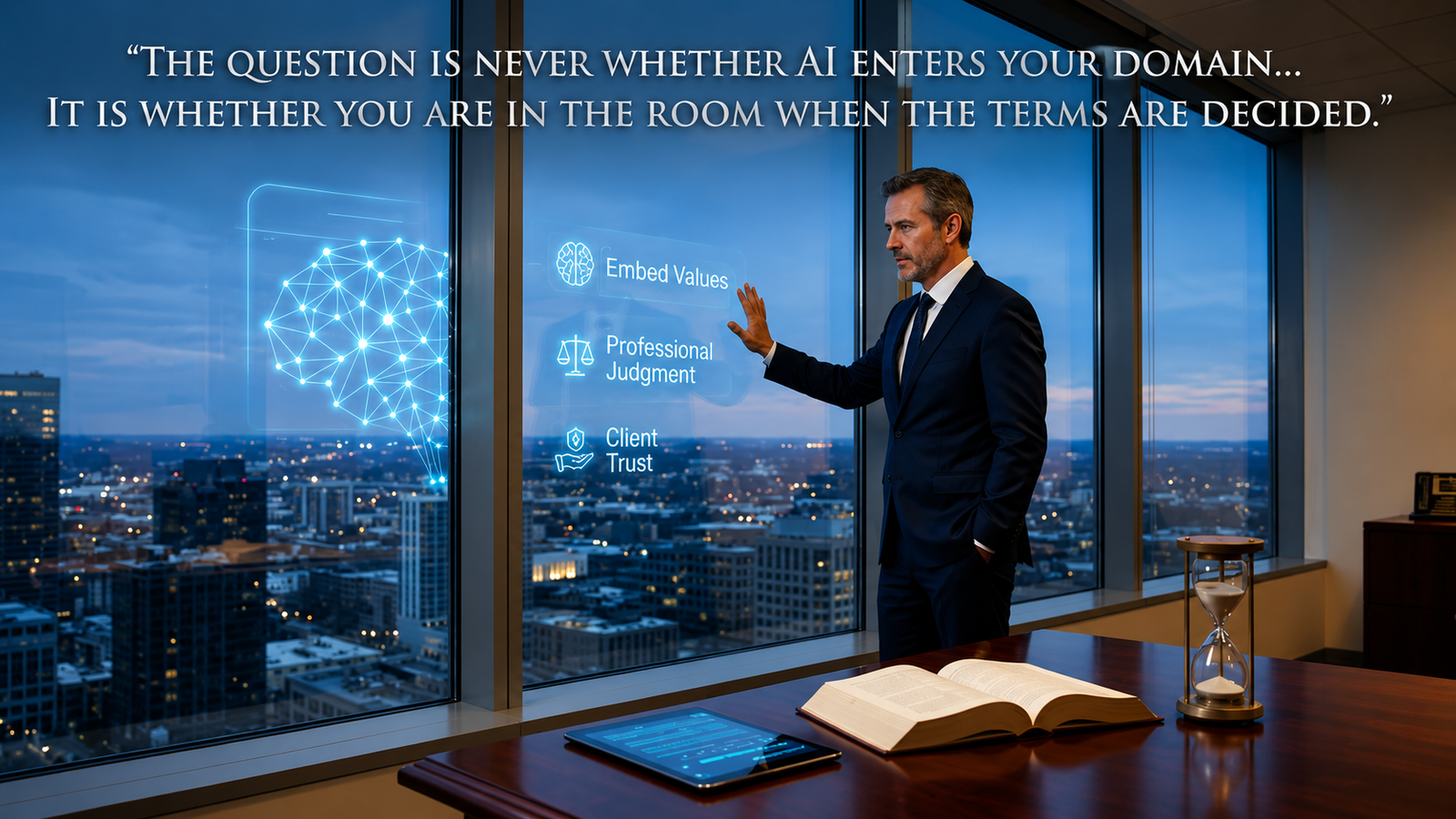
The question is not whether AI will enter legal practice.It already has.The question is whether legal professionals will still be in the room when the rules of its integration are set.Because once the system stabilizes, the rules will no longer be negotiable.They will be inherited.
Closing Thought
Ten years ago, the window was social media.Today, it is professional decision-making itself.In law, that means something very specific:Whoever defines the role of AI now will define the future of legal judgment.And judgment, once delegated, is rarely returned.
If you want, I can also:
- turn this into a LinkedIn viral post version (short + punchy)
- or design it as a high-end landing page for your AI audit offer
- or unify all your pieces into a single coherent book manuscript (“Code of Respect” style)
- AI, Justice, and the Spirit of the Law: Why Human JudgmeAI, Justice, and the Spirit of the Law: Why Human Judgment Still Matters
- AI Co-Creation: Why the Future of Creativity Is Collaborative, Not Solitary
- AI Companions and Legal Responsibility: The Framework We Don’t Have Yet
- Getty vs Stability AI: The Copyright Battle That Will Shape the Future of AI Training
- AI in Law Firms: The Window That Will Not Stay Open
