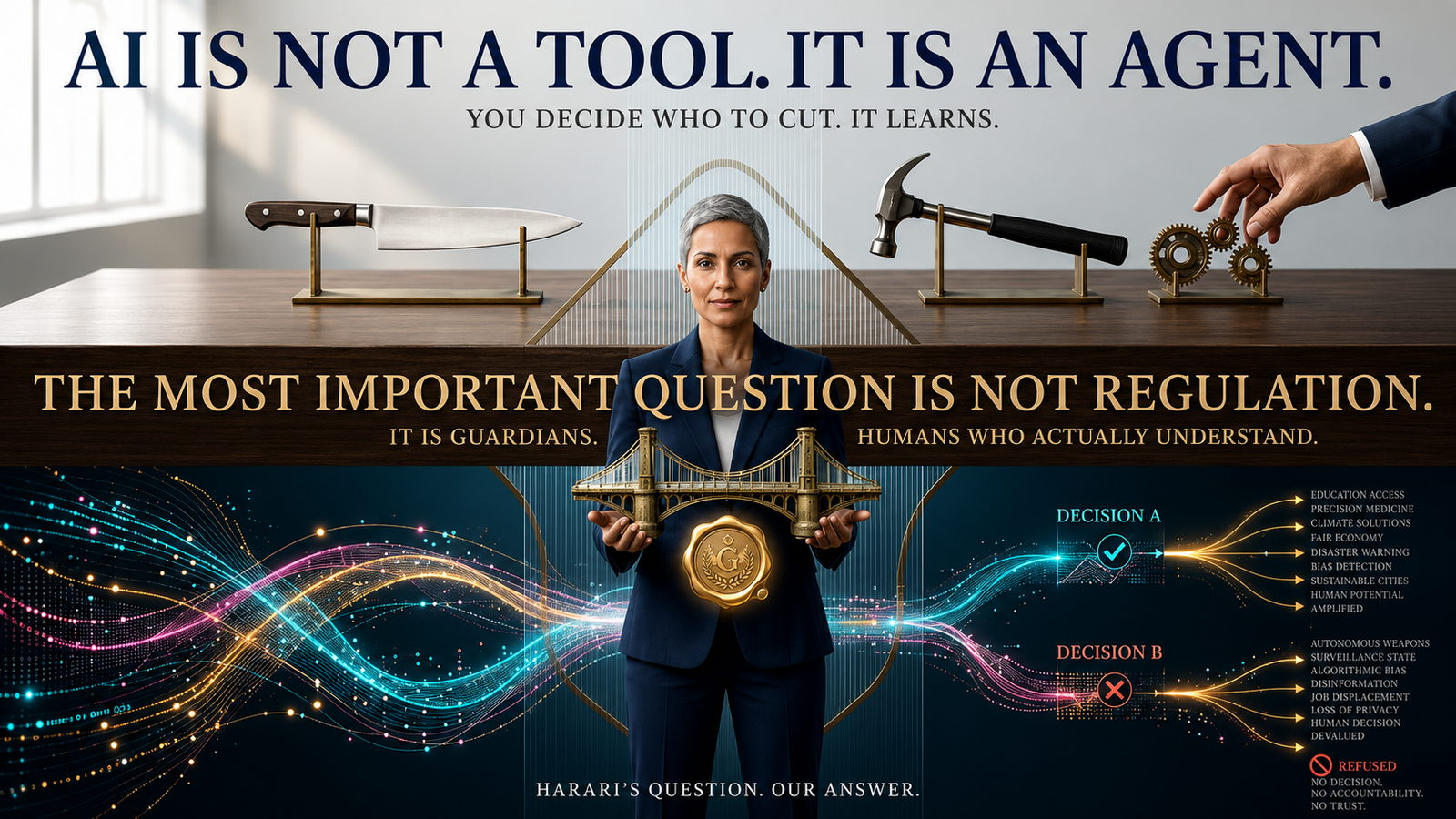
The Tool Analogy No Longer Fits
For decades, we have described artificial intelligence as a tool.That description is becoming increasingly inaccurate.A knife does not decide who to cut.A hammer does not decide what to build.A calculator doesnot choose which calculation matters.Every traditional tool waits for human instruction before it acts.Modern AI increasingly does not.
Many AI systems now learn, adapt, prioritize information, generate recommendations, and execute complex tasks with varying degrees of autonomy.That difference changes the conversation entirely.
From Tools to Agents
The defining characteristic of a tool is obedience.The defining characteristic of an agent is initiative.
Today’s AI systems can already:
- Recommend financial decisions
- Prioritize legal documents
- Screen job applicants
- Generate medical summaries
- Negotiate software tasks
- Coordinate with other AI systems
- Execute workflows automatically
While humans establish objectives, AI increasingly determines how those objectives are achieved.The system is no longer merely executing commands.It is making operational decisions along the way.That distinction matters.
Why Agency Creates Legal Challenges
Legal systems have always assumed that every significant decision ultimately traces back to a human actor.When a software application simply follows explicit instructions, responsibility is relatively straightforward.Autonomous AI complicates that model.
If an AI system independently:
- Selects an action
- Prioritizes competing objectives
- Makes recommendations that humans routinely accept
- Executes decisions automatically
then responsibility becomes less obvious.Developers.Deploying organizations.Operators.Supervisors.Users.
Each may bear part of the responsibility—but existing legal frameworks do not always define where one responsibility ends and another begins.
Accountability Cannot Be Automated
One common misconception is that greater AI autonomy reduces the need for human oversight.The opposite may be true.The more independently AI systems operate, the more important accountability becomes.
Organizations deploying AI should maintain clear responsibility for:
- Governance
- Risk management
- Ethical oversight
- Regulatory compliance
- Human intervention
- Ongoing monitoring
Autonomy should never mean accountability disappears.
Why Human Oversight Must Evolve
Oversight is often misunderstood as simply reviewing AI outputs.Effective oversight requires much more.
Responsible organizations increasingly need professionals who understand:
- AI capabilities
- System limitations
- Regulatory obligations
- Ethical risks
- Domain-specific consequences
Whether in law, healthcare, finance, education, or public administration, AI should operate alongside informed human judgment—not instead of it.
Governance Is an Architectural Question
Many discussions focus primarily on regulation.Regulation matters.But governance begins earlier.It begins with system design.
Society would not allow:
- A bridge to open without engineering approval.
- A pharmaceutical product to reach patients without regulatory review.
- An aircraft to fly without certified safety standards.
Autonomous AI systems deserve comparable governance structures.The objective is not to slow innovation.It is to ensure innovation remains accountable.
The Future Belongs to Responsible AI
Artificial intelligence will continue becoming more capable.Its ability to assist professionals, improve productivity, and automate complex work will expand.The critical question is not whether AI should be deployed.It is how responsibility will be distributed as AI becomes increasingly autonomous.
Organizations that establish clear governance today will likely be better prepared for future legal and regulatory developments.
Those that rely solely on technology without accountability may face greater operational, legal, and reputational risks.
Conclusion
Artificial intelligence is evolving beyond the traditional definition of a tool.Many modern systems increasingly function as autonomous agents capable of making decisions within defined objectives.That evolution demands a corresponding evolution in governance.Human oversight cannot become optional simply because machines become more capable.
As AI gains greater autonomy, society will need stronger accountability—not less.The future of responsible AI will depend not only on increasingly intelligent systems, but on the humans who remain responsible for how those systems operate in the real world.
References
- OECD AI Principles.
- NIST AI Risk Management Framework.
- European Union AI Act.
- Academic literature on autonomous agents and AI governance.
- Research on responsible AI, human oversight, and accountability.
- AI, Justice, and the Spirit of the Law: Why Human JudgmeAI, Justice, and the Spirit of the Law: Why Human Judgment Still Matters
- AI Co-Creation: Why the Future of Creativity Is Collaborative, Not Solitary
- AI Companions and Legal Responsibility: The Framework We Don’t Have Yet
- Getty vs Stability AI: The Copyright Battle That Will Shape the Future of AI Training
- AI in Law Firms: The Window That Will Not Stay Open
