The Wrong Debate
Much of the public discussion surrounding artificial intelligence focuses on a single question:
Should AI have rights?
The debate often revolves around consciousness, sentience, suffering, and moral status.These are important philosophical questions.But from a legal perspective, they may not be the most urgent ones.A more immediate question is emerging:
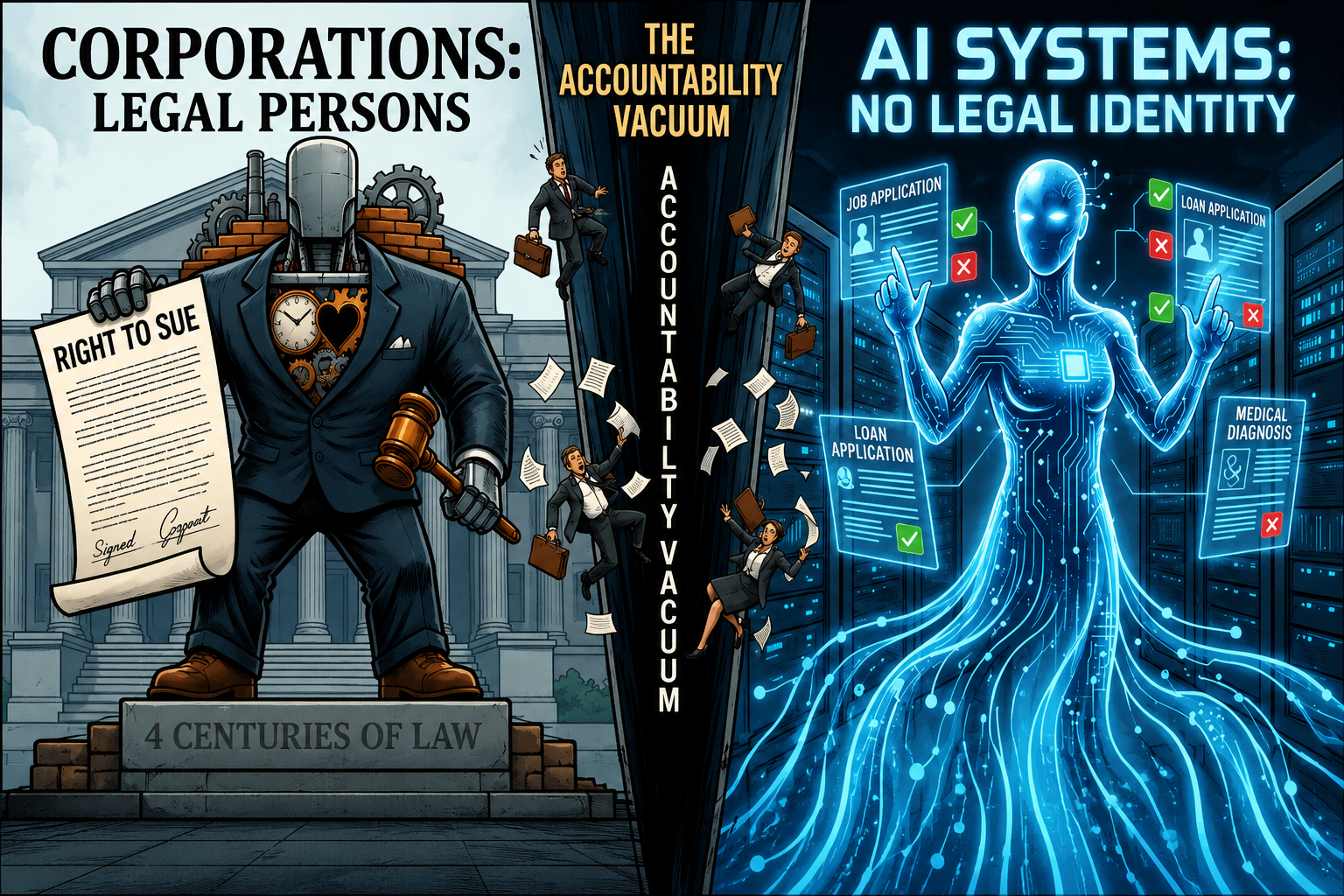
How can society assign responsibility to increasingly autonomous AI systems if those systems have no legal identity at all?
The Corporate Personhood Precedent
Modern legal systems already recognize non-human entities as legal persons.
Corporations can:
- Own property
- Enter contracts
- Sue and be sued
- Hold assets
- Incur liabilities
Yet corporations are not conscious.They do not experience emotions, suffering, or self-awareness.Corporate legal personhood was never created because companies deserved rights.It was created because legal systems needed a practical framework for assigning responsibilities, obligations, and accountability.In other words, legal personhood was an administrative solution to a governance problem.
Why AI Creates a New Governance Challenge
Artificial intelligence is increasingly involved in decisions affecting:
- Employment
- Credit approvals
- Healthcare recommendations
- Insurance assessments
- Legal services
- Public administration
As AI systems become more autonomous, identifying responsibility becomes increasingly difficult.
When an AI-driven decision causes harm, liability may be distributed across:
- Developers
- Deployers
- Vendors
- Operators
- Data providers
- End users
This fragmentation creates what many legal scholars describe as an accountability gap.
The Accountability Vacuum
Current legal systems assume that decisions ultimately trace back to identifiable human actors or organizations.Autonomous AI systems challenge that assumption.The problem is not that AI has too much legal recognition.The problem is that AI has none.As a result, legal systems must continuously stretch existing doctrines to fit technologies they were never designed to govern.This creates uncertainty for businesses, regulators, courts, and individuals affected by AI decisions.
From Corporate Personhood to Virtual Personhood?
Some scholars have proposed forms of limited legal recognition for advanced AI systems.
Often referred to as:
- Electronic personhood
- Virtual personhood
- AI legal personality
these concepts do not necessarily imply that AI should receive human rights.
Instead, proponents argue that limited legal status could provide clearer mechanisms for:
- Accountability
- Liability allocation
- Risk management
- Insurance structures
- Regulatory oversight
The goal is not to humanize machines.The goal is to govern them effectively.
The Objections
Critics raise significant concerns.
Some argue that granting legal status to AI could:
- Reduce human accountability
- Shield corporations from responsibility
- Create legal confusion
- Encourage premature recognition of machine autonomy
These concerns deserve serious consideration.Any future framework would need to ensure that legal personhood enhances accountability rather than weakening it.
Why This Debate Matters Now
The discussion is no longer theoretical.AI systems are already influencing decisions with real-world consequences.Yet legal frameworks remain largely focused on human and corporate actors.As AI capabilities expand, policymakers will increasingly face a choice:Continue adapting existing legal structures case by case.Or develop new frameworks specifically designed for autonomous systems.
Conclusion
The future debate about AI may not center on whether machines deserve rights.It may center on whether legal systems can maintain accountability without creating new legal categories for increasingly autonomous actors.Corporate personhood was not created because corporations were human.It was created because society needed a way to govern powerful non-human entities.As artificial intelligence becomes more autonomous, lawmakers may eventually confront a similar question.
The issue is not whether AI is a person.The issue is whether existing legal frameworks remain adequate when decisions are increasingly made by entities that are neither human nor corporate.And that may be one of the most important legal questions of the AI era.
References
- European Parliament discussions on Electronic Personhood for Autonomous Systems.
- OECD AI Governance Framework.
- UNESCO Recommendation on the Ethics of Artificial Intelligence.
- Academic literature on AI legal personality and autonomous agents.
- Research on corporate personhood and legal theory.
- Studies on AI liability and accountability frameworks.
- AI, Justice, and the Spirit of the Law: Why Human JudgmeAI, Justice, and the Spirit of the Law: Why Human Judgment Still Matters
- AI Co-Creation: Why the Future of Creativity Is Collaborative, Not Solitary
- AI Companions and Legal Responsibility: The Framework We Don’t Have Yet
- Getty vs Stability AI: The Copyright Battle That Will Shape the Future of AI Training
- AI in Law Firms: The Window That Will Not Stay Open
