Is Law More Than Words?
Artificial intelligence is rapidly transforming legal practice. It can analyse legislation, review contracts, search case law, draft legal documents, and summarise thousands of pages within minutes.As these capabilities improve, an increasingly important question emerges: If AI can master the language of the law, can it also understand justice?
The answer depends on whether law is simply a collection of words or something more.
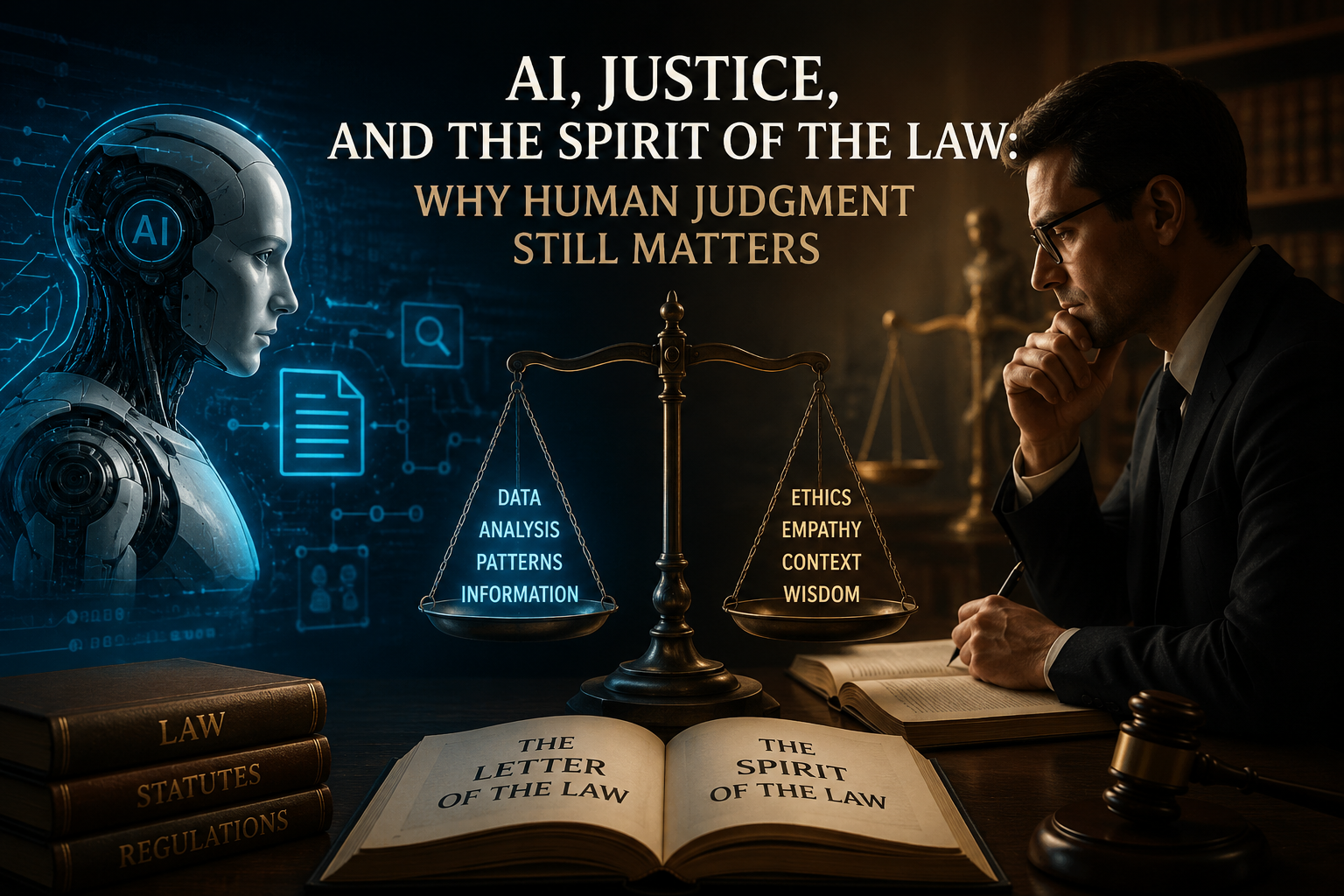
The Difference Between the Letter and the Spirit
Legal systems have always operated on two levels. The first is the letter of the law the written rules, statutes, regulations, and precedents that provide consistency and predictability. The second is the spirit of the law the underlying principles of fairness, dignity, proportionality, and justice that give those rules meaning. Judges and lawyers routinely navigate the relationship between these two dimensions. The written rule may appear straightforward. Its application rarely is. Every legal dispute involves context, competing interests, human consequences, and ethical judgment.
Those elements cannot always be reduced to text alone.
AI Excels at the Letter of the Law
Modern AI systems are exceptionally well suited to language-intensive work.
They can:
- Search millions of legal documents
- Compare statutory provisions
- Identify relevant precedents
- Draft legal submissions
- Review contracts
- Summarise complex litigation
- Detect inconsistencies across documents
These capabilities make AI an increasingly valuable tool for legal professionals. For many routine tasks, it already performs faster than humans. As large language models continue to improve, these advantages are likely to expand.
Judgment Is More Than Information
Legal practice has never depended solely on information. A judge deciding a difficult case does more than identify applicable statutes. A lawyer advising a client does more than quote precedent. Professional judgment requires balancing legal rules with context, ethics, practical consequences, and human experience. Clients do not seek legal advice merely to obtain information. They seek trusted judgment from someone willing to accept responsibility for that advice. This distinction becomes even more significant as AI becomes increasingly capable of producing legal language.
Why Accountability Remains Human
Artificial intelligence can recommend legal strategies. It cannot bear professional responsibility in the way lawyers and judges do. Legal systems depend on accountability. Someone must ultimately answer for legal advice, judicial decisions, ethical obligations, and professional conduct. Responsibility cannot simply be delegated to software. For that reason, many discussions surrounding AI governance increasingly focus not only on technological capability but also on maintaining meaningful human oversight in legal decision-making.
The Future of Legal Practice
Artificial intelligence will almost certainly automate many language-based aspects of legal work.
Research.
- Drafting.
- Document review.
- Knowledge management.
- Compliance analysis.
These developments are likely to improve efficiency throughout the profession. At the same time, they may clarify the unique contribution lawyers make. As AI assumes more responsibility for processing legal information, human professionals become increasingly valuable for exercising judgment, building trust, resolving uncertainty, and protecting justice. Technology may transform how legal services are delivered. It does not eliminate the need for human wisdom.
Law Needs More Than Intelligence
Legal systems exist to protect people—not simply to process information. The ability to interpret language accurately is essential. The ability to apply that language with fairness is equally important. Artificial intelligence can strengthen legal practice by improving efficiency and expanding access to information. Whether it strengthens justice depends on how humans choose to govern, supervise, and ultimately remain accountable for its use. The future of law will not be determined solely by better algorithms. It will also depend on preserving the human capacity to distinguish between what the law permits and what justice requires.
Conclusion
Artificial intelligence is becoming exceptionally capable at mastering the language of law. It can organise information, identify patterns, and generate sophisticated legal analysis. Yet legal systems were never built on language alone. They also depend on judgment, responsibility, dignity, and ethical interpretation.As AI increasingly masters the letter of the law, the defining challenge for lawyers, judges, and policymakers will be preserving the human qualities that give the law its purpose. The future of legal practice will not simply ask who can interpret the rules.
It will ask who remains responsible for protecting the values those rules were created to serve.
References
- Research on artificial intelligence in legal practice.
- Literature on legal philosophy and the rule of law.
- Publications on AI governance and responsible AI.
- Research on legal ethics and professional judgment.
- Studies on AI-assisted legal decision-making.
- AI, Justice, and the Spirit of the Law: Why Human JudgmeAI, Justice, and the Spirit of the Law: Why Human Judgment Still Matters
- AI Co-Creation: Why the Future of Creativity Is Collaborative, Not Solitary
- AI Companions and Legal Responsibility: The Framework We Don’t Have Yet
- Getty vs Stability AI: The Copyright Battle That Will Shape the Future of AI Training
- AI in Law Firms: The Window That Will Not Stay Open
